
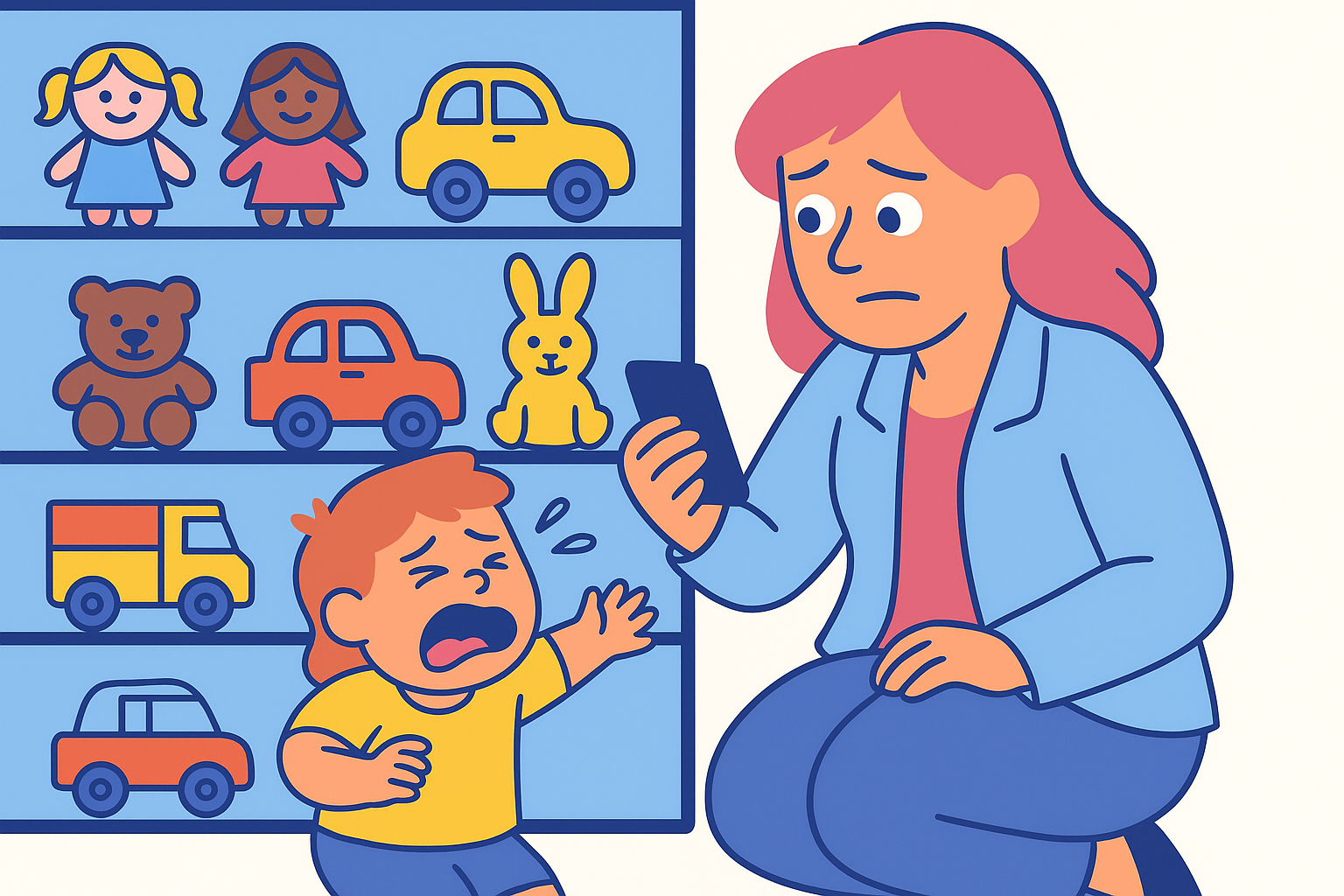
Parenting is hard enough behind closed doors, but when a meltdown happens in public, that’s when the pressure really kicks in. Suddenly you’re not just trying to calm your child; you’re also trying to manage the stares, the judgments, and your own racing heart.
Gentle parenting doesn’t mean giving in to every demand. It means seeing your child’s big feelings for what they are—human—and responding with empathy while still holding boundaries. Here are some real-life situations every parent knows too well, and how a gentle shift in response can make all the difference.
1. The Toy Store Tantrum
We’ve all been there: your child spots a shiny toy on the shelf and it’s like the universe stops spinning until they get it. When you say no, the tears and wails follow. The usual instinct might be to say, “Stop crying, we’re not buying that!” But gentle parenting asks us to pause.
Instead, get down to their level and let them know you see them: “I know you really wanted that toy. It looks fun.” Then set a boundary without giving in: “We’re not buying it today, but I’ll take a picture and we can add it to your birthday list.” This way, they feel understood, and you’re teaching patience and limits at the same time.
2. Talking Too Loud in Public
Whether it’s the grocery store, a restaurant, or the library, kids have a special talent for picking the exact wrong time to be the loudest version of themselves. Our gut reaction might be to hiss, “Shhh! Stop yelling!” but that usually just adds more tension.
A gentler approach is to whisper back, “Let’s use our library voices,” modeling the behavior instead of scolding. You can also redirect their energy: “Can you help me count the apples while we shop?” And if they’re restless beyond repair, sometimes the kindest solution is a quick reset outside instead of fighting it out in the moment.
3. Refusing to Leave the Playground
Few things are harder than trying to drag a child away from the playground or mall play area. The default might be to bark, “Stop it! We’re leaving right now.” But transitions are tough for little ones, and they need help moving from one activity to the next.
Try giving a clear warning: “We’ll play for 5 more minutes, then it’s time to go.” Offer a choice to give them some control: “Do you want to go down the slide one last time or climb one last time?” When the protest inevitably comes, hold firm but empathetic: “I know you wish we could stay all day. It’s hard to leave. Let’s wave goodbye to the playground together.”
4. Food Drama at a Restaurant
You’ve ordered their favorite, but suddenly tonight it’s “yucky.” Cue the crossed arms, tears, or full meltdown at the table. It’s tempting to say, “Just eat it or else!” But that only turns mealtime into a power struggle.
Instead, stay calm: “I see you don’t like this right now.” Then offer limited choices: “Would you like to eat the pasta or just have some bread for now?” Keep the boundary clear: “This is what’s for dinner. You don’t have to eat it, but we’re not ordering something else.” The goal isn’t to force food; it’s to remove the battle and preserve peace.
5. The Overtired, Overstimulated Meltdown
Airports, parties, busy grocery stores—sometimes the environment itself is too much for a little body to handle. The child starts crying, flopping, or screaming, and the embarrassment for us parents kicks in. The harsh words come out: “Stop it, you’re embarrassing me.”
But gentle parenting invites us to shift the focus. Instead of shaming, reduce the stimulation: step outside, find a quiet corner, or just hold them close. Co-regulate by breathing slowly and using a soft tone: “There’s so much going on. You’re tired and it’s a lot. Let’s take a break.” Often, fewer words and more presence do the trick.
Final Thoughts
Gentle parenting in public doesn’t mean you’ll avoid meltdowns. They’re going to happen because kids are kids, and big feelings are part of growing up. What it does mean is approaching those hard moments with empathy, connection, and calm boundaries.
And when you slip up (because you will), remember: what matters most is not perfection, but repair. A hug, an apology, a whispered “I’m here, I love you” — those are the moments your child will remember far more than the meltdown itself.



Leave a Reply